I sat down to trade last Friday morning in a genuinely great headspace. The night before, I’d been out seeing live guitar music, and honestly, the last two weeks of trading had been some of my best—disciplined, systematic, and totally calm. My small cash account had grown 13% in the previous session alone, going 3 for 3 on a day I read the tape perfectly. I was a little tired from the late night, but I felt good. Confident. Ready.
About fifteen minutes before the open, I did exactly what I’m supposed to do. I looked at the four indexes—all of them were sitting above the PSC and trending bullish on the 5-minute in premarket. I noted that oil, which had been trading inversely to the broader market during the Iran situation, was down slightly after two big up days. I pulled up the daily SPY chart and started drawing my levels.
And that’s when the chart told me something completely different from what the 5-minute chart was saying.
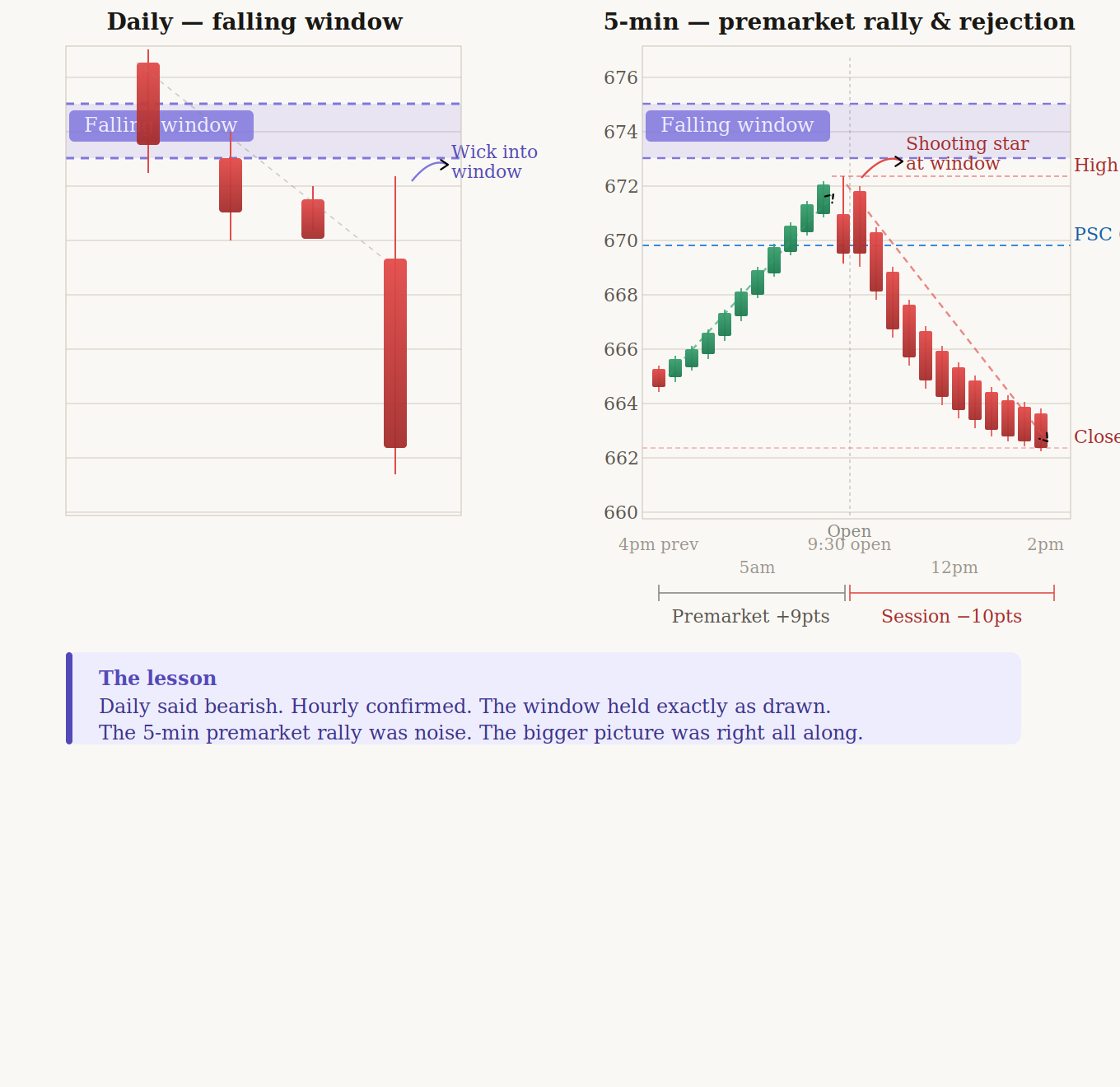
The daily showed a “falling window”—a gap that had formed two days prior, sitting right there as resistance. It wasn’t subtle. It was a clear, undeniable zone. The hourly confirmed it: mostly red candles pressing up into the top of the wave, running directly into that window. MACD was bearish. Squeeze Pro was bearish. Everything on the bigger timeframes was pointing in one single direction.
I was bearish. I wrote down 672.50 as my put level — halfway into the window. I put in a buy order for puts and waited. Price got within 15 cents of my level. Never filled.
And that’s where the story should have ended.
But I waited. 20, 25, 30 minutes. Patient at first — watching the price come down toward the 10-minute T-Line (8ema). Then something shifted. Instead of watching the daily and hourly, I found myself staring at the 5-minute candles. Zoomed in. Immersed. Living inside a timeframe that was telling a completely different story than the charts that actually mattered in the bigger picture.
The 5-minute trend was bullish. Price was above the PSC. And my inner daytrading voice — the one that says calls above PSC, puts below PSC — started getting louder than the voice that had drawn that window on the daily.
I told myself: “It’s okay to change direction. The 5-minute trend says so.”
I bought calls.
What followed was one of the worst sessions I’ve had in months. I added to the calls when they went against me. I bought NVDA calls at the same time — it was on my calls list, it hit a buy level, so I took it. Later, I added more SPY calls, 0DTE this time. In a separate account, I bought IWM calls with a week out. Each new position expanded the total money at risk. Each one doubled down on a thesis that my own analysis had already rejected before the open.
I had sticky notes with my -25% stop levels written down for each position. I didn’t honor a single one. The notes were sticky, but not to my brain.
By the close, the cash account that had grown 13% the day before was down roughly 35%.
What I did wrong, in order of damage
Rule 1: I changed my direction. The daily window, the hourly red candles, the MACD, the Squeeze Pro — the read was bearish, and it was right. The market went down all day. I just wasn’t in it. I was on the wrong side of it, adding to losing calls, while the puts I originally wanted printed exactly as I’d predicted. Direction is first. You’ve got to get the direction right. All that other daytrading analysis is horse wash if your direction is wrong.
Rule 2: I got sucked into the 5-minute. The zoom-in trap is a painful one. The chart didn’t change. My perspective did. When you stop looking at the daily and start living inside the 5-minute, the bigger picture doesn’t disappear; you just kind of stop seeing it. That falling window was there the entire session. I had zoomed past it.
Rule 3: I added to losers. Every additional entry (the second SPY call, the NVDA, the IWM) expanded the damage. “Kill the monster when he’s small.” I fed the monster instead.
Rule 4: I ignored my stops. The -25% rule exists because that’s the math. If your target is 25% and you hold past a 25% loss, you’ve destroyed the reward-to-risk ratio that makes the system work. The sticky note was right there. The stop wasn’t honored.
But underneath all four of those mistakes was something I didn’t fully see until I sat down to write this
Yesterday set me up.
Going 3 for 3 the day before on the index trades — including some creative direction reads that went my way — created a subconscious sense of immunity. My brain filed it as: I can bend the rules and win. That belief walked into the market with me Friday morning, quieter than conscious thought, more dangerous than any bad setup.
I didn’t actually want to trade calls. I wanted to make money. And I found a way to talk myself into a trade I never believed in, from a direction my own analysis had already rejected, and I held it with delusion until the account was meaningfully smaller than it had been two days ago.
The whole session I felt chest stress. That constant low-grade pressure of trying to mentally will a losing trade into turning around. That feeling is your body telling you the truth before your brain is willing to admit it.
I’ve been in trades that moved against me temporarily and felt calm because I believed in the setup. This was not that. This was dread. And I held through it anyway.
The market validated my original bearish thesis all day. The daily window held as resistance exactly as I’d drawn it. The puts I’d planned to buy would have been winners. My analysis was right. My execution was rogue.
There’s a word for when you know the rules, write down the rules, have the rules on a sticky note, and then don’t follow them. It’s not bad luck. It’s not a system problem. It’s a YOU problem. And the only way through a YOU problem is to name it honestly and understand why it happened.
So that’s what I’m doing here. If you’ve ever found yourself in a trade you don’t believe in, adding to a position that’s bleeding, or holding past your stop because “this time feels different,” this post was written for you. You’re not incompetent. You’re not unlucky. You just went rogue.
This content is for educational purposes only and is not financial advice. Always do your own research.